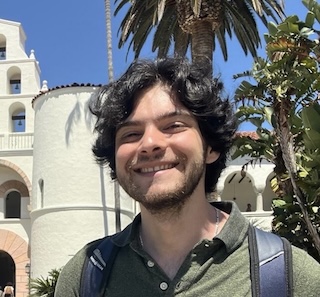
Sam Yaziji is a writer from Miami, Florida. He is an MFA student in poetry at San Diego State University, where he also works as the print production editor for Poetry International. His poems have been published or are forthcoming in Zone 3 Press, Apocalypse Confidential, and the Bicoastal Review. He has research forthcoming in Pulse: The Journal of Science and Culture. His research interests include Eastern Christian hymnography, post-phenomenology, and cybernetics.
Connect with Sam
I had a pair of orange shoes I played tennis in growing up. I couldn’t even tell you the brand at this point, it’s been so long, but I loved them and they lasted for ages. I won some good matches with those.
My parents had a 2001 Honda Odyssey when I was growing up. It’s probably my favorite car by default, because I don’t feel particularly attached to any other car. It was silver and spacious, and the seats were unbelievably comfortable.
Sunset Place Mall, which I hear is going to get torn down or drastically remodeled soon. I’ve written some poems about that mall and I’ll miss it when it’s gone—it’s a Vaporwave mecca. Also, the neighborhood in Ft. Lauderdale where my grandparents’ old house was. I wrote a poem about that place but I’ll probably never share it with anyone. Also, the Old Florida Book Shop in Davie, which I discovered by accident one day. Coconut Grove also has a special place in my heart.
My dad is from Syria and came to the US in the 90s. My mom was born in Cuba but came to the US with her parents when she was very young. My mom grew up in South Florida and has spent most of her life there since, so I enjoy hearing her stories, especially from being part of the disco scene and experiencing the craziness of partying in Miami in the 80s. She’s always been super cool. She’s an artist, so a lot of her work borrows from local traditions—for instance, Havana tiles and the culture of the Tequesta peoples. She’s taught me a lot about the city and its heritage.
I had a wonderful experience growing up in Miami. People are embedded in the city in a way I haven’t encountered elsewhere. I think I benefited from this strong cultural element, which is so deeply influenced by its Caribbean heritage, but also by places like Brazil and Argentina. I definitely see myself going back there, and hopefully living there until my death.
Mr. Shanoskie, Mrs. Arboleda, Mr. Cox
Miami is known for its multicultural blend. How do you see your own identity within that mix, and does your poetry reflect the cultural layering that Miami embodies? How does it influence your view of boundaries—personal, artistic, or cultural?
I was blessed to grow up around my maternal grandparents, who came from Cuba in the 60s and lived most of their lives in South Florida. They never learned English, and their Cuban culture was overwhelming in the best possible way, though I struggled with it in certain moments. I miss them. There’s a certain lack of boundaries in Cuban culture, a real Nietzschean spirit. In its best manifestation, people are radically authentic, brutally honest. Materialism comes with that, too, and in its extreme, so does a kind of repulsive, self-loving disposition. I’ve had to learn to temper myself because of this, and have tried to learn how to be quiet and a little less selfishly assertive, though I still often struggle with that. The aspects of Syrian culture I grew up with—a sense of sophistication and old-world mystique, as well as an awareness of international geopolitics—also balance out the more rugged Cuban elements. The superficiality people commonly associate with Miami comes from the culture of the more recent transplants, I think.
It’s been transforming in certain exciting ways, and also in some really annoying ways. There’s a kind of “finance bro” subculture that has been imported, which is pretty cringe. But there’s also a lot more of a cultural interest and artistic appreciation in Miami now than there was when I was growing up. I guess there’s more to do nowadays—more art films being shown, more literature being produced, etc.
The sound of the train pulling into Dadeland North station. It brings me right back to the angst and ecstasy of life in high school, since I took the train to and from school every day. While I was in (Zoom) college during COVID, my dad moved to an apartment right above that station, and those memories just repeated over and over again in my brain. That train ran late into the night and kept me awake, so I also remember a kind of sleepless haze when I hear it now.
I have those moments of transcendence all the time. Listening to Michael Jackson when I was eight on my parents’ computer. Reading St. Augustine’s Confessions for the first time when I was losing my mind five years ago. Reading Jack Gilbert for the first time in college. Coming across scans of the magnificent Book of Kells for the first time. Seeing some Ugarit-inscribed clay tablets in Syria when I was a kid. Listening to Fairuz as a kid—I always loved old music and wanted to emulate that soulful, poetic performativity when I was first introduced to her music. I’ve always been a lay archivist and enjoyer of cultural artifacts, so even the discovery of an inspirational object, text, or artist can be transcendent for me.
Some of my favorite writers in any genre are Tomas Transtromer, Yukio Mishima, Tu Fu, J.L. Borges, Arsenii Tarkovsky, Cristina Campo, William Gaddis, Li Po, Adonis, Blas Falconer, Flannery O’Connor, Ezra Pound, Mahmoud Darwish, Ernst Junger, Sandra Alcosser, Ghassan Kanafani, Brigit Pegeen Kelly, Thomas Pynchon, Sarah Maclay, Georg Trakl, Cormac McCarthy, Roberto Bolaño, Wang Wei, Friedrich Holderlin, Vasko Popa, Michel Houellebecq, R.M. Rilke, and Nizar Qabbani. Some new inspirations for me are Scott Cairns, Arthur Kayzakian, Trinity Catlin, Jon Tobias, Grace Matthews, Natalie Ezelle, Artrice Bennett, Joey Rougas, Zea Sandoval, Rosalynn Blaisdell, Em Teaze, Carson Sandell, Luis Torres, Alana Rodriguez, and Ale Hernandez. I am always inspired by the great theological poetry of Sts. Ephrem the Syrian, Symeon the New Theologian, John of Damascus, Kassiani, Romanos the Melodist, and Gregory of Nazianzus.
My favorite book growing up was The Lord of the Rings. Some books I’ve enjoyed recently are Giorgio Agamben’s Language and Death, H.G. Gadamer’s The Beginning of Philosophy, Pavel Florensky’s The Meaning of Idealism, and Richmond Lattimore’s translation of the Odyssey.
Words I’m attached to: gesture, form, inscribe, marble, loom. Words I don’t like (which I think are a little overused): urgent, body, subjective.
In the words of Saint Cleopa of Sihăstria: “Death! Death! Death!”
I always like to push a little bit up against the discursive boundaries set by the zeitgeist—there are certain hot-button topics that put the poetry world into an obsessive trance, and I like to ignore those sometimes. I’m always happy to keep the boundary between the sacred and the profane.
I always prefer to write when I’m a little hungry, or otherwise unsatiated.
There’s no rhyme or reason to my own writing practice. Inspiration comes when it comes, and I can’t pin it down to a certain mood, place, or moment. Often, I only write a few words at a time—up to four or five lines max. When I revisit my scribbles, that’s when the poem emerges.
I have to be careful not to get wrapped up too much in an aesthetic persona or transient mood. It is easy to lose myself to my poetic “voice,” since I write a lot of persona poems. Ideally, I’d like my writing to be something in complete concordance with my faith—in Orthodox Christianity, ascetic practice is not considered scientific or merely moral work, but the “art of arts.” That is why the ideal kind of knowledge is not “philosophia” (love-of-wisdom) but “philokalia” (love-of-beauty). Even the flesh is transfigured in beauty by attaining the knowledge of God. I hope that my life in faith will increasingly inform my writing in this way.
Generally, I prefer not to talk about my writing, so I’m happy when people don’t ask about it. But my poems generally demand a little bit of effort from the reader, and I’m always happy to see when they research something after reading a poem of mine. I like allusions and conceits because writing about my boring life frankly doesn’t make for good reading. Also, I’m 23, so not much of note has happened yet.
I’ve been playing the drums longer than I’ve been writing—particularly drum set, but also hand percussion—the bongos, the doumbek (a Middle Eastern goblet drum) and the riq (a Middle Eastern tambourine). I had the privilege of contributing drums to a recent album by my friend Natalie Wong (who plays under the moniker Renaissance Woman), called Nature Jazz. I make music too (it’s on Spotify). I also like to paint Christian icons.
I often don’t write about my faith. It’s hard to say what has been revealed in ways more beautiful than I can ever manage to convey. I’d hope that my faith emerges naturally and subtextually in my writing. I don’t like the didactic mode—the rhetoric of modernity sullies poetry. I also think that too much openness can be dangerous: “Guard your heart, for everything you do flows from it” (Proverbs 4.23).
Regarding the first question, I actually don’t. For me, writing is technical—it has its transcendent moments, particularly in the joy of composition, of seeing the gestalt of the poem come to life—but it doesn’t reach the celestial heights of prayer, which obviously doesn’t mean it’s necessarily bad. In my best moments, my writing can lead me to prayer, reorienting my mind towards it and opening the possibility for that space.
I’ve noticed that a lot of people my age, regardless of their faith background, have been returning to some kind of religious observance. I actually think our recent ancestors (Boomers through Gen-X) were more secular than we are, in a sense. I do feel a responsibility insofar as I am called to live life as a Christian, and that means to love everyone (especially my enemies), take up my cross, and live in quiet obedience to Christ. I don’t feel the need to evangelize to my peers. St. Seraphim of Sarov says “acquire the Spirit of Peace and a thousand souls around you will be saved.” Orthodoxy is ascetic in this way—I should represent my faith outwardly and silently in my actions, and I shouldn’t nag people or proselytize. But I fall short of this every day.
I doubt myself all the time as a writer. I am a continent of doubt. When I doubt my writing, I set it aside for a while (sometimes months) and come back to it with a clearer head. This is probably why I only write 10-15 passable poems in a year. But when I have doubts in my faith, I respond by praying and then seeking guidance from someone who is more spiritually adept than I—my priest or an elder in the Church.
To me, writing is the crafting of that space. I begin a poem in a moment of anger or sorrow, and by writing the poem, I try to create something beautiful out of my abjection. I often emerge in a space of peace and contentment. I only ever want my writing to be a conduit for peace, but I fall short of this mission all the time.
I used to feel a sense of alienation, since Miami can often feel like a place which is so antithetical to the Orthodox “phronema.” It’s profane in many ways, and a real locus for spiritual confusion—but this is probably the case with every major city. After all, in global postmodernity, every city is a mirror-image of every other city. I’d hope that my faith doesn’t stand out, unless it’s when I do some good in the world. Nowadays, I try to see the image of God in everyone, and I thank God for everyone He has put into my life. Miami is beautiful—people are approachable and kind and real, in spite of the cultural profanity which exists in the city.
I agree, but I think that the challenges and blessings are the same as they ever were—the former being the same passions of the flesh that have plagued us since the fall, the latter being the Kingdom of Heaven, which, as the Son of God tells us, is “not of this world” (John 18.36).
I see it more as a personal exploration, but I’m really delighted when readers connect with my (occasionally-overt) spiritual themes. St. Porphyrios says, “whoever wants to become a Christian must first become a poet.”