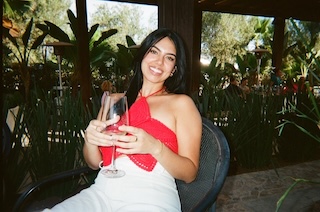
Angela Mendoza is a Chicana, Central American-American writer hailing from the Bay Area in Northern California. She recently graduated from the MFA program at San Diego State University, where she taught classes in literature and creative writing. She’s presented at the RE: Border conference in San Diego as well as the Latinx Literary Conference in New York City. She is currently teaching at U.C. San Diego and working on her debut novel.
Connect with Angela on IG: @angelasmendoza
I don’t have a favorite pair of shoes but I do have a pair of shoes I often think about. My mother received her first pair of shoes as a gift from her father for her 8th birthday. She lived in Costa Rica, and played in the sugar cane fields with her sisters. Sugarcane is burned on the night before harvest in order to make the harvesting process easier. My mother went out to play one evening, took her shoes off–she wasn’t used to playing in shoes so they were uncomfortable–and forgot them. The next morning she ran back for them but it was too late. They melted down. Sometimes these shoes pain me, and sometimes they make me feel joy, but I think about them a lot.
My favorite car ever is a 1970’s Cadillac Eldorado Coupe. It’s smooth. It’s sexy. It’s got a mean grill that warns you to stay away but lures you in at the same time. The body of the car is so long, it just keeps going on and on and on and on and—
I don’t think any part of Roseland belonged only to me. That’s what I loved—and still love—about it so much. It was always ours; everybody’s. I felt small there because there were always so many of us. My grandparents’ house was full of family by sundown. My dad’s check cashing joint was full of migrants sending money home to loved ones. On Sunday’s the streets were full of people cruising in and out of the hair salon, the joyeria, Sam’s Cafe. We were all always there.
Growing up in Roseland was very humbling. It wasn’t a “nice” place if we’re abiding by the American suburb definition. My parents sent me to school in the next town over, and the white kids there saw Roseland as ghetto. It made me see Roseland as ghetto too. I grew up to love ghetto.
My mami was born in Costa Rica and migrated on visa to the United States when she was 25, my current age. My father was born in Mexico and crossed the border without papers in the back of a white lady’s van. They met in Santa Rosa through my dad’s cousin, whose wife was from my mami’s hometown in Costa Rica. When my mami’s visa was up, my dad asked her to marry him so she could stay. They hadn’t been together for more than 6 months.
I look more like my father: brown skin and eyes. I have his exact million dollar smile. My mother is fair skinned and green eyed. But I have my mother’s rage. I think that makes me resonate with her more.
I’m lucky enough to have the world’s most romantic partner, so I go to him. Just the other day he picked me up from work and the car was full of red rose petals, covering the seats and the floor. There was even a lit Palo Santo candle, my favorite scent. I mean, c’mon. It was just a regular-degular day. Who does that?
A physical location in Roseland that inspires my creativity is my grandparent’s old house on Rose Meadow Court. There’s so much history there, good and bad. I often find myself coming back to the streets of the neighborhood itself. Rose Meadow Court is also right off of West Ave, which is right off of Sebastopol Road. I grew up walking up and down Sebastopol Road, the main strip of Roseland. Things, people were always coming and going in Roseland.
Roseland was my first example of the beauty and closeness of immigrant communities. I’m lucky to have experienced it and be a product of it. A lot of latino/a folks in the United States don’t get to experience a neighborhood like that. They become removed from the cultura. Traditions included the taco truck, western union money transfers, the intersection of Sebastopol Rd and West Ave, cowboy boots, tending rose bushes, little two door pick-up trucks, the dollar tree, chelas on summer nights for the adults and fresh oranges in the morning for the babies. Oh, and Foster’s Freeze. I’ll never stop reppin Roseland.
There are certain places we hold sacred. For Roseland, some example, I pulled place from a google search like Roseland Creek Park or Creek Tunnels. Do any of these places resonate with you?
None of these places resonate with me. A lot of them are outside Roseland. This is a perfect example of one of those times where you just had to be there. You really had to be in it–you can’t google my hood.
How much space do I have? Roseland is almost unrecognizable to me now. My grandparent’s house is run down, with junk in the yard and the rose bushes have disappeared. My dad’s check cashing joint of 30 years on Sebastopol Rd is a barber shop now. The dollar tree went out of business. They put in an outdoor event space that made it on the news for its food trucks and live music, but gave all the credit to the umbrella area of ritzy “Sonoma County,” without even mentioning the name Roseland or people who made the hood what it is. Like my tia, who’s responsible for lots of the community’s gardens.
The women at the taco truck calling out order numbers in Spanish. I hope they’re getting enough sleep.
My nana’s living room floor. It’s always warm and quiet there. I take naps on the carpet and there’s always food to eat when I wake up.
Roseland gave me my Chicana roots. We had so much Mexican culture around and so much assimilation at the same time. Growing up I watched my family become more and more Americanized while trying to hold space for our Mexican hearts. I can’t talk about my Chicanidad and not mention Roseland.
I once came across one of my father’s many notebooks and found a journal entry about me. I was a baby, and he described watching me sleep. He wrote about my little belly moving up and down softly with my breath. My father wasn’t–still isn’t–the type to show emotion. It was the first proof I had of his heart. I was 12 and I taped it on the back of my door. I’ve tried to find it over the years, but I’ve never been able to find it again.
I’m someone who’s easily inspired. Some constant inspirations: My family. A sunny day. The ocean. Traveling. Meeting a new person. Toni Morrison. Dancing. Newer inspirations: My partner’s mind. Los Angeles. Open mic’s. My cousin who doubles as my built-in best friend. A hot outfit.
Growing up my favorite book was The Woman in the Wall by Patrice Kindl. I read it so many times. I can barely remember what it’s about, but I think the main character ends up having a fulfilled crush. As an adult, my favorite novel is Sula by Toni Morrison and my favorite book of poetry is Citizen Illegal by José Olivarez. Recently, I’ve been reading Elizabeth Acevedo’s poetry.
My favorite word is lovely. I also like the words west, ocean, and eterno. I hate the words wiggly, stress, and toilet.
I constantly write about love and I used to hate that about myself. But I’ve realized I have to write about what excites me during that time. I might spend these 10 years writing about love, but that doesn’t mean I can’t spend the next 10 years writing about womanhood, or flowers, or death, or activism.
I like to talk on the phone with my mom or paternal grandmother before I begin writing, if I can. I only speak with them in Spanish and a lot of my creativity comes from the Spanish language. Their melodies and word choices often give me fresh ideas or jumping off points for a scene or line. Also, a sweet treat while writing is a nice reward.
A writing process to me is a series of adjustments. What worked for me one day might not work for me the next. But I have to keep writing, so I’ll adjust to whatever will make my process most successful that day. One thing I will say is that writing in longhand will always get me out of a rut and produce my best writing. I owe that trick to a literature professor.
Writing is more about living life than observing it. We live so that we have good things to write. Observations fall flat and dull, but experiences can be made immortal through writing. Writing is also liberation, but liberation must be practiced in order to combat years of oppression, therefore we must keep writing to truly employ liberation.
This is a great question. I guess I wish people would ask to read my work more. I think this would help hold me accountable.
Most people don’t know how spiritual I am. I’m pretty deep into a spiritual journey. I do a fair amount of meditation, healing classes, psychic work, journaling, yoga, and more. Oh, and therapy.
Sebastopol Road, the Main Street in Roseland, comes up in my writing a lot. Also, the home that my father lived in with his parents and siblings when they first migrated to Califas, is the setting of my novel. I’ve only ever visited it from the outside, but my tia has described the inside to me in detail.
I would really like to write a collection of short stories that take place on Sebastopol Rd. I think I’d center it around the unique characters of the hood though, and the setting would offer grounding for the characters.
This makes me want to tear up. To the Roseland of my childhood: I’m sorry. I love you. To the Roseland of the future: We’ll always remember you the way you truly were.
Being Chicana is everything to me. It’s what I’m most proud of. I’m wearing the gold bamboo hoops with my name across the middle in my predominantly white workplace because I’m Chicana down. To me, being Chicana enacts preserving and progressing at the same time. I preserve what my Mexican culture has morphed into in this new region, especially throughout the 90’s. At the same time, I progress the Mexican identity and culture into something more representative of the Mexican-American experience. My Chicanidad has created a pathway for my most authentic self to transpire, which is a complex, nuanced, mix of the cultures I was born into, as well as the cultures I’ve grown up around or been introduced to by loved ones.
Representing Chicana voices in literature feels more like a privilege than it does a responsibility. It’s come to me very naturally and I can’t really separate it from my personal storytelling. Being Chicana is in my heart and soul, and I can’t take my heart or soul out of my art. I love it that way.
In my opinion, the west coast has the strongest roots for Chicano/a culture, especially in Southern Califas due to the presence of the movement and the saturation of Mexican culture. I wouldn’t be as rooted anywhere else. The West does it best.
Luis Rodriguez was the first Chicano writer I ever read. I couldn’t believe someone was actually documenting our experience so honestly and so formally. Literature and Chicanismo had not yet intersected in my young mind. When it finally did, through Rodriguez, my world expanded into a panorama view. It gives me chills to think about how I felt the first time I read his work. I thought to myself, people actually read this? And care? Oooouuuueee. I was so excited. As a woman, Selena Quintanilla’s influence will always be seen in my hair, make up, clothes, and attitude.
I love in Spanish. I love like my mami. Filled with fire and rage and sadness and everything at once, pero con amor incondicional. Speaking in Spanglish is my most authentic self. That’s when I vibrate the highest, too. I can say to someone “te amo mas que mi vida” and it means so much more than saying “I love you more than my life”.
I want us to demand space. I want us to familiarize the world with our experience. I want them to see us even when they want to hide us or remove us. I hope my work demands attention in ways my person doesn’t.